
What is the Logiesdecreet and who does it apply to?
The Logiesdecreet is the Flemish decree governing tourist accommodation. It dates from 5 February 2016 and has applied since 1 April 2017. Its logic is simple: as soon as accommodation is offered to the public for payment, it falls within the scope of the decree.
Its reach is much wider than hotels. An apartment in Knokke let for fifteen nights a year on Airbnb is tourist accommodation within the meaning of the decree. So is a holiday home in De Panne. The owner's status makes no difference: private individual or company, the obligation is the same.
Mind the geography. The Logiesdecreet applies only in the Flemish Region. The whole Belgian coast, from De Panne to Knokke, falls under it. Walloon or Brussels rules are different and cannot be transposed.
What are the 9 basic standards to comply with?
Tourist accommodation must comply with nine basic standards, at all times and not just on the day of the inspection.
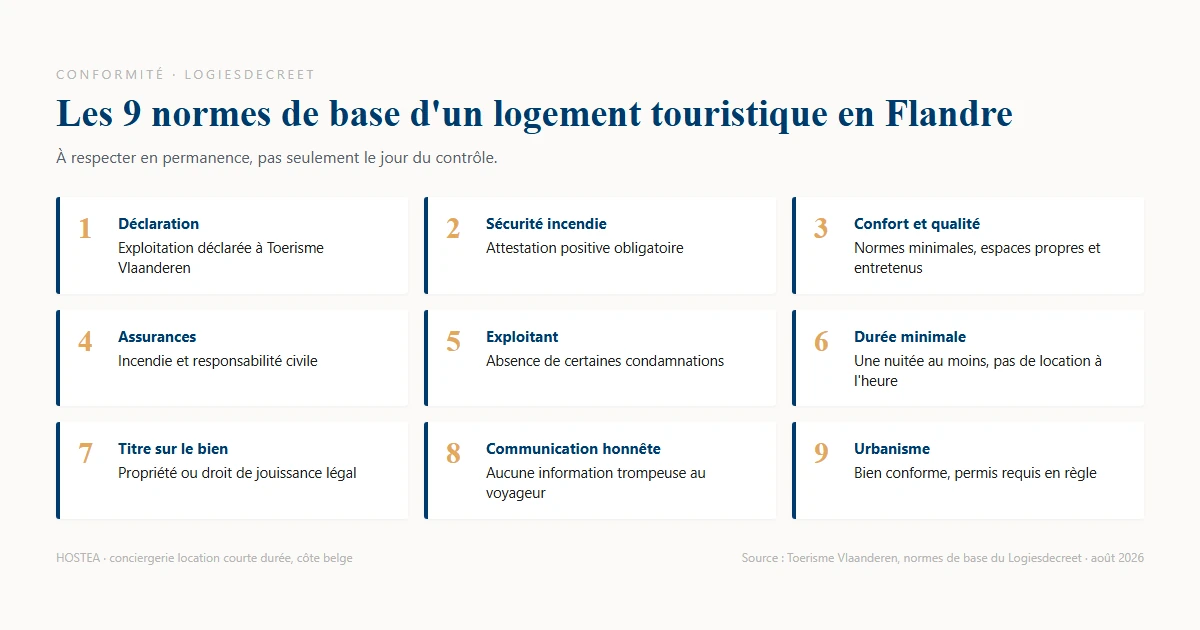
- The operation is declared to Toerisme Vlaanderen.
- The accommodation has a positive fire safety certificate.
- It meets minimum standards of comfort and quality, in clean and well-maintained spaces.
- It is covered by fire insurance and civil liability insurance.
- The operator has not been the subject of certain convictions.
- Each let covers at least one night: no letting by the hour.
- The operator holds a title of ownership or a legal right of use over the property.
- Communication about the accommodation is truthful and does not mislead guests.
- The property complies with planning rules, including permits.
Two of them most often block the files we see on the coast: fire safety and planning. The first requires an inspection and a budget for compliance work. The second can be a stumbling block for a property converted without a permit, a converted attic or an apartment split that was never regularised.
Standard 8 is often underestimated. It requires truthful communication about your accommodation. A listing that promises a non-existent sea view or a higher capacity than the reality is not just a commercial risk. Note: Toerisme Vlaanderen specifies that certain matters, including spatial planning, taxation and misleading advertising, fall under other regulations that it does not enforce itself (see the "basisprincipes logiesdecreet" page in the sources).
How do you register your accommodation with Toerisme Vlaanderen?
Registration, or aanmelding, is the first step. It is done either through Toerisme Vlaanderen's operator portal (option 1) or with a form returned by email or registered post (option 2). In both cases, have your electronic identity card (eID) ready.

You declare the identity of the operator, the address of the property, the type of accommodation and its capacity. In return, the accommodation receives a unique registration number (uniek registratienummer). Via the portal, it arrives immediately by automatic email; via the form, a few days later, and you cannot host guests in the meantime. The accommodation is entered in the public register and becomes subject to inspection.
This declaration is mandatory for everyone, professionals and private individuals alike, including for occasional letting via Airbnb or Booking.com. It is not a formality of convenience: it is basic standard number one.
The portal is in Dutch. If you do not speak the language, get help rather than filling it in by guesswork: an incorrectly declared capacity then skews the entire fire safety file.
Aanmelding or erkenning: what is the difference?
These two words come up often and are regularly confused.
| Aanmelding (declaration) | Erkenning (recognition) | |
|---|---|---|
| Nature | Mandatory | Voluntary |
| Purpose | To make the operation legal | To obtain official recognition and a comfort classification |
| Consequence | Registration number, entry in the register | Comfort classification or stars, which you choose whether or not to display |
In other words: without aanmelding, you cannot let legally. Without erkenning, you can let, but you do not display an official classification.
What happens if the obligations are not met?
The most tangible point is fire safety. Without a positive certificate, operation is prohibited. A negative type C certificate prohibits letting until the situation is regularised.
Beyond that, accommodation listed in the register may be inspected. Except for planning, a breach of the basic standards exposes you to an administrative fine of 250 to 25,000 euros (Article 12, § 1 of the decree). The amount is doubled if a new offence is established within five years (Article 12, § 2). This "Handhaving" chapter has been in force since 1 April 2026. Source: consolidated text, Codex Vlaanderen, accessed on 10 September 2026.
Be careful about the exact scope. Planning compliance does not fall within the scope of this fine. Article 12 covers the other basic standards, not that one. Toerisme Vlaanderen does not inspect it; it falls under other authorities, with their own procedures and penalties. For your specific case, ask Toerisme Vlaanderen or a lawyer for confirmation.
One development has changed the picture since 2023: the DAC7 directive. Every year, platforms send the tax authorities the identification details of hosts, their income and the number of transactions. Short-term rental is no longer an administrative blind spot.
How do you pass the fire safety inspection without handing over management?
With HOSTEA Conform', you have your property brought into fire safety compliance without signing a management agreement. It is a one-off service, on quotation, designed for owners who manage their own listings and bookings and simply want to pass their inspection. It covers the whole Belgian coast, from De Panne to Knokke.
The scope follows the fire safety part of the Logiesdecreet, from audit to inspection: audit of the property, ISO 7010 signage, evacuation plan, Benor fire extinguisher and detectors, preparation of the file, then attendance at the appointment with the inspection body. You receive a quotation before any work is carried out. The details of the services and the prices are shown on the offer page.
Two limitations, stated upfront rather than afterwards. The timing depends mainly on the availability of the inspection body, which we do not control. And if your property has an underlying planning problem, no fire safety service will solve it: we will tell you before you sign, not after.
And if you would rather delegate the entire management?
HOSTEA is also a short-term rental property management company, active on the Belgian coast, from De Panne to Knokke. Under a management agreement, Logiesdecreet compliance is part of the service: registration with Toerisme Vlaanderen, fire safety certificate file, insurance checks, declaration of municipal tourist taxes.
Upkeep of the property and the quality of the spaces are covered by our cleaning and linen providers. Guests use self check-in with a key lock box. The management agreement is not a prerequisite: Conform' can be ordered on its own, and the question of management can come up later, or never.
Please note. This article is for information only and is dated. Regulations change and your case depends on the type of accommodation, its capacity and the municipality. Have your situation validated by Toerisme Vlaanderen, your fire and rescue zone or a lawyer before making any binding decision.
Frequently asked questions
Does the Logiesdecreet apply to occasional letting?
Do you need a registration number to list on Airbnb?
Is the fire safety certificate part of the Logiesdecreet?
Does the decree apply in Brussels or Wallonia?
Can you handle fire safety compliance without handing over the management of your property?
Want to pass your fire safety inspection without delegating management? Request a HOSTEA Conform' quote.
Request a HOSTEA Conform' quoteWould you rather hand over the entire management? Let's spend 20 minutes discussing your property.
Further reading
Sources
- Toerisme Vlaanderen, Basisnormen van het Logiesdecreet: https://toerismevlaanderen.be/nl/logies/basisnormen
- Toerisme Vlaanderen, Aanmelding: https://toerismevlaanderen.be/nl/logies/aanmelding
- Toerisme Vlaanderen, Basisprincipes van het Logiesdecreet (scope of inspections): https://toerismevlaanderen.be/nl/logies/basisprincipes-logiesdecreet
- Toerisme Vlaanderen, Brandveiligheid in logies: https://toerismevlaanderen.be/nl/logies/brandveiligheidsnormen
- Logiesdecreet (5 februari 2016), consolidated text, Codex Vlaanderen, Article 4 (ten conditions) and Article 12 (Chapter 5 Handhaving, in force from 01/04/2026), accessed on 10/09/2026: https://codex.vlaanderen.be/PrintDocument.ashx?id=1026527
- FPS Finance, DAC7: https://fin.belgium.be/fr/particuliers/declaration-impot/revenus/dac7
- Regulation (EU) 2024/1028 of 11 April 2024 on data collection and sharing relating to short-term accommodation rental services, OJ L of 29/04/2024, Article 7(1)(b) and Article 19 (applicable from 20 May 2026), accessed on EUR-Lex on 10/09/2026: https://eur-lex.europa.eu/legal-content/FR/TXT/?uri=CELEX:32024R1028