
Updated on 14 September 2026
By Victor Timmermans, founder of HOSTEA · Published on 14 September 2026
Ostend is the largest city on the coast, and it is also the one where an owner is most likely to get things wrong. The issue is not tax, it is planning: before talking about returns, you need to know whether your address can legally host guests. This guide summarises the regulations in force on 14 September 2026, including the City's written reply.
Does the City still issue holiday rental permits?
No, except in certain zones. The City's official FAQ on omgevingsvergunningen, accessed on 14 September 2026, says so bluntly: "Op dit moment kunnen we geen omgevingsvergunningen voor vakantieverhuur verlenen. We wachten hiervoor op de opmaak en goedkeuring van de nieuwe gemeentelijke beleidsvisie." No holiday rental permit is being granted for the time being, pending the new municipal policy vision.
The permit requirement does not come from the City but from the Flemish Government Order of 14 April 2000 on changes of use. Its article 2 lists "wonen" and "verblijfsrecreatie" among the main uses: letting the entire dwelling to guests changes its main use and requires an omgevingsvergunning. Only a complementary use in a dwelling that remains lived in is exempt, subject to conditions (article 2, § 3). Ostend is not inventing the rule; it has decided to stop granting permits.
The consequence is serious and must be stated plainly. Outside the four zones below, a property that does not already have its permit cannot obtain one today. The dienst Omgevingsvergunningen confirmed this in writing to HOSTEA on 11 September 2026: the new municipal policy vision has not been adopted and no date is known. The freeze therefore has no end date.
Two points remain unresolved by this reply. The City did not specify whether permits are actually being issued in the four RUP zones during the freeze. Nor did it say what happens to holiday homes already being let without a permit outside these zones. Ask both questions in writing before making any commitment.
Which four zones are still open?
Four municipal spatial implementation plans, cited in the City's FAQ, allow tourist use. The dienst Omgevingsvergunningen confirmed in writing on 11 September 2026 that this list is complete and up to date. A nuance worth knowing: in Kustfront and Raversijde, the reference to "dag- en verblijfsrecreatie" appears in the explanatory column (toelichting), not in the prescriptive column. It is the City's reading that opens the way to a permit. The headings below are those of the voorschriften:
- RUP Kustfront, articles 1 and 6. Article 1 covers the "multifunctioneel stedelijk woongebied" and its "recreatieve voorzieningen (dag- en verblijfsrecreatie)". Article 6 explicitly mentions hotels and recreational facilities.
- RUP Raversijde, article 1, "het kustlint", which allows housing-related facilities, including verblijfsrecreatie.
- RUP Hazegras, articles 1 and 2. Article 1 is the "Multifunctioneel stedelijk woongebied", a residential zone with its housing-related facilities, including recreational facilities, with no further detail in the text read. Article 2 is headed "Strategische projectzones", strategic project zones; only its heading was read.
- RUP Stedelijke Economische Verweving, article "Multifunctioneel Stedelijk Woongebied". Its explanatory memorandum states that these uses are possible as a main use, as the restriction to an ancillary use under the former BPAs no longer applies.
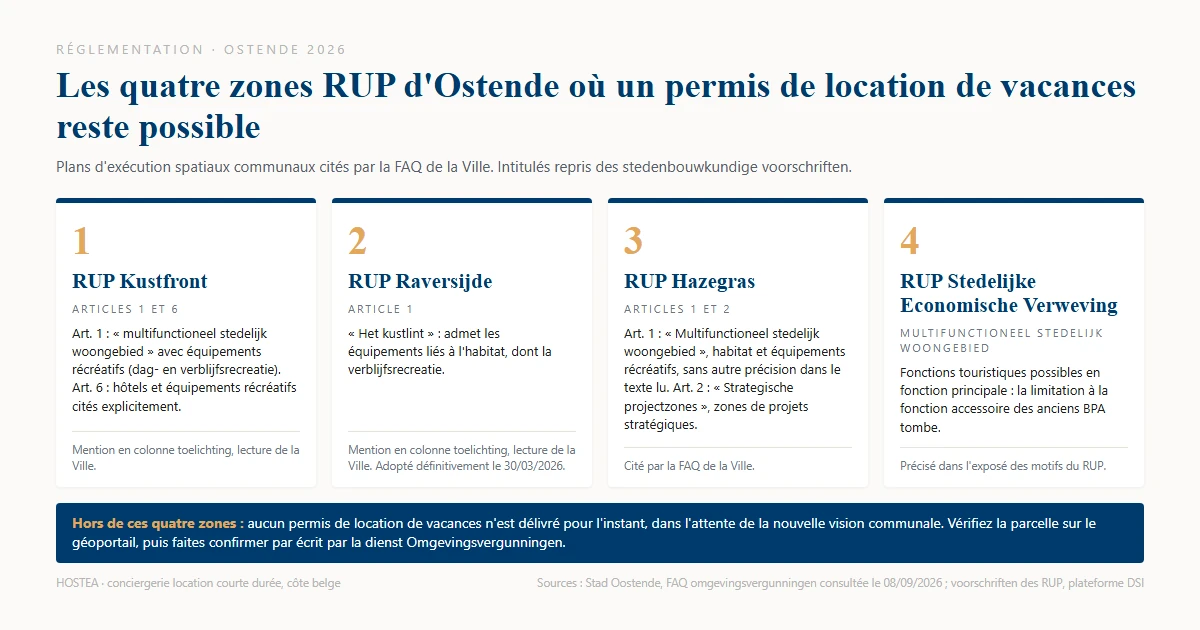
An address cannot be assessed from a street name or a distance from the seafront. Check the plot on the municipal geoportal, then have it confirmed in writing by the dienst Omgevingsvergunningen before any purchase or commitment. At the same time, ask whether a permit is actually being issued there during the freeze: the reply of 11 September 2026 does not say. An oral confirmation does not protect you.
Can you rely on the 4 × 30-day exemption?
It applies, but it only covers four stays per calendar year. This is the written position of Ostend's dienst Omgevingsvergunningen, received by HOSTEA on 11 September 2026. The City's official FAQ now publishes the same count, in point 4 "Tijdelijke vakantieverhuur zonder omgevingsvergunning" (accessed on 14 September 2026). Article 7.3 of the Vrijstellingenbesluit of 16 July 2010 exempts from the permit requirement a temporary change of main use limited to four periods of thirty consecutive days per calendar year. The City does not dispute this text; it specifies how it is counted.
The count is strict. The thirty-day period starts on the first day of each let, whether it lasts one night or thirty. A break opens a new period at the next let. So does a change of guest, even with no empty day between two stays: one family from 1 to 4 June, then another from 5 to 8, already makes two periods.
The consequence, as written by the City: four separate stays per calendar year exhaust the exemption, even if they are four isolated nights. It is not a pool of 120 days to spread as you like. The conclusion that follows is HOSTEA's, not the City's: four stays a year rule out any seasonal or continuous holiday letting. The Flemish text refers to a change of use, not to guests; for an Ostend application, it is the City's reading that counts.
Do not confuse this count with the "occasionele vakantieverhuur" tax rate, capped at 120 days a year, detailed in the next section. This rate has nothing to do with planning: paying €275 authorises neither 120 days of letting nor a fifth stay. The tax regulation says so itself: payment is independent of the planning situation.
How much do the municipal taxes cost in 2026?
Two annual taxes, which are cumulative. This is intentional: the official procedure published by the City requires you both to register the property as a second home and to declare the verblijfsbelasting.
| Property where no one is domiciled (second home status assessed on 1 January) | Verblijfsbelasting | Second-residence tax | Annual total |
|---|---|---|---|
| Property offered permanently | €825 | €1,186 | €2,011 |
| Occasional letting, 120 days a year maximum | €275 | €1,186 | €1,461 |
Source: Ostend municipal council regulations of 27 April 2026 (verblijfsbelasting, article 3) and of 13 December 2025 (tweede verblijven, article 3). The 1 January date applies only to the second-residence tax, which is due once for the year. The verblijfsbelasting is due quarterly (article 4), pro rata if the operation stops or is transferred during the quarter (article 7), or if it closes for renovation for at least 30 days, requested in writing before the works (article 5).
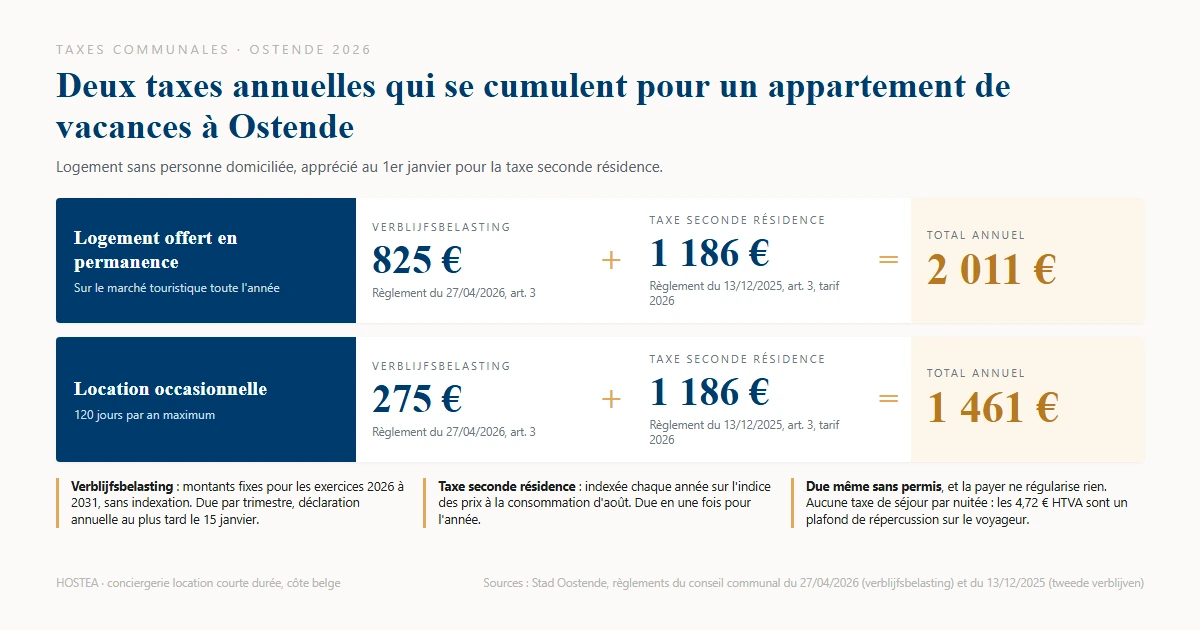
The verblijfsbelasting stems from the municipal council regulation of 27 April 2026, published on 29 April 2026, for the tax years 2026 to 2031. Its two amounts are flat: no indexation, no annual increase until 2031. The second-residence tax comes from the regulation of 13 December 2025, with a 2026 rate of €1,186, which is indexed every year to the August consumer price index. Its article 6 provides for targeted exemptions (unoccupied property put up for sale or rent, major energy renovation, letting to the public social welfare centre (CPAS), among others): check them before paying; none of them covers holiday letting.
Three points that owners discover too late:
- The tax is due even without a permit. The regulation says so: "De betaling van de belasting staat los van de stedenbouwkundige en al dan niet vergunde toestand van het logies." And paying it does not regularise anything.
- The declaration is annual, by 15 January at the latest. Without a declaration, or in the event of an incorrect declaration, the ex officio assessment comes with a 50% surcharge for the first offence and 100% for the second, under article 8 of the regulation of 27 April 2026, which refers to the procedure in article 7 of the decree of 30 May 2008.
- Simply registering with Toerisme Vlaanderen is enough to trigger the tax. The definition of taxable accommodation covers property offered on the tourism market and/or notified to Toerisme Vlaanderen.
There is no per-night tourist tax in Ostend. The figure of €4.72 excl. VAT that you will see circulating, set by article 3 of the regulation of 27 April 2026, is a cap on what can be passed on to the guest, per unit and per night, not a tax owed to the City. Likewise, the 120-day cap of the occasional rate is purely fiscal: it is neither a permit nor a count of the 4 × 30 days.
Who pays: the owner or the intermediary?
This is what sets Ostend apart, and it deserves your attention if you delegate. The regulation defines the liable party as any person who offers tourist accommodation on the market, or any person who offers it as an intermediary, in the name or on behalf of a third party. A property management company that publishes and markets the listing may fall within this definition; the classification has not been settled.
Unlike De Panne or Nieuwpoort, the regulation provides neither a joint and several liability clause nor a presumption designating the owner where no operator is known. Who bears the tax must therefore be settled in black and white in the management agreement, and the liable party confirmed by the dienst Belastingen. At HOSTEA, this is a prerequisite for any signature in Ostend.
Which Flemish obligations still apply?
The planning blockage suspends none of the rest. Two regional obligations must be met before the first paid night:
- The aanmelding with Toerisme Vlaanderen, mandatory even for a single night a year. The registration number must be received before welcoming the first guest (Toerisme Vlaanderen aanmelding page, accessed on 10 September 2026).
- The fire safety certificate, issued by ACEG vzw, the body designated by Toerisme Vlaanderen for small accommodation falling under bijlage 2: 1 to 3 units and a maximum of 9 sleeping places, or 1 unit of 10 to 12 sleeping places outside a larger building complex. In other cases (bijlages 2/1 and 3), the certificate is requested from the mayor, with the inspection carried out by Hulpverleningszone 1 West-Vlaanderen. Vinçotte, the former body, ceased this activity on 28 September 2025 (Vinçotte page accessed on 10 September 2026).
A property can therefore comply on the Flemish side and remain blocked on the municipal side. The reverse is just as possible: a permit in an RUP zone does not exempt you from either the aanmelding or the fire safety certificate.
How HOSTEA Commun' handles your formalities in Ostend
HOSTEA Commun' brings together the municipal and regional formalities for a holiday let, with or without a management agreement: written confirmation of the zone from the municipality, a dimensioned furnished plan, preparation and submission of the permit application in the Omgevingsloket with follow-up until the decision, support with the Toerisme Vlaanderen registration and the verblijfsbelasting declaration. One municipality, one application, a single point of contact.
In Ostend, the first step carries more weight than elsewhere. We ask the dienst Omgevingsvergunningen to confirm in writing whether your plot falls within one of the four RUPs where a permit remains possible. This confirmation determines what follows. Once the measurements have been taken, the application goes into the Omgevingsloket within five working days. The City's processing time, on the other hand, cannot be promised.
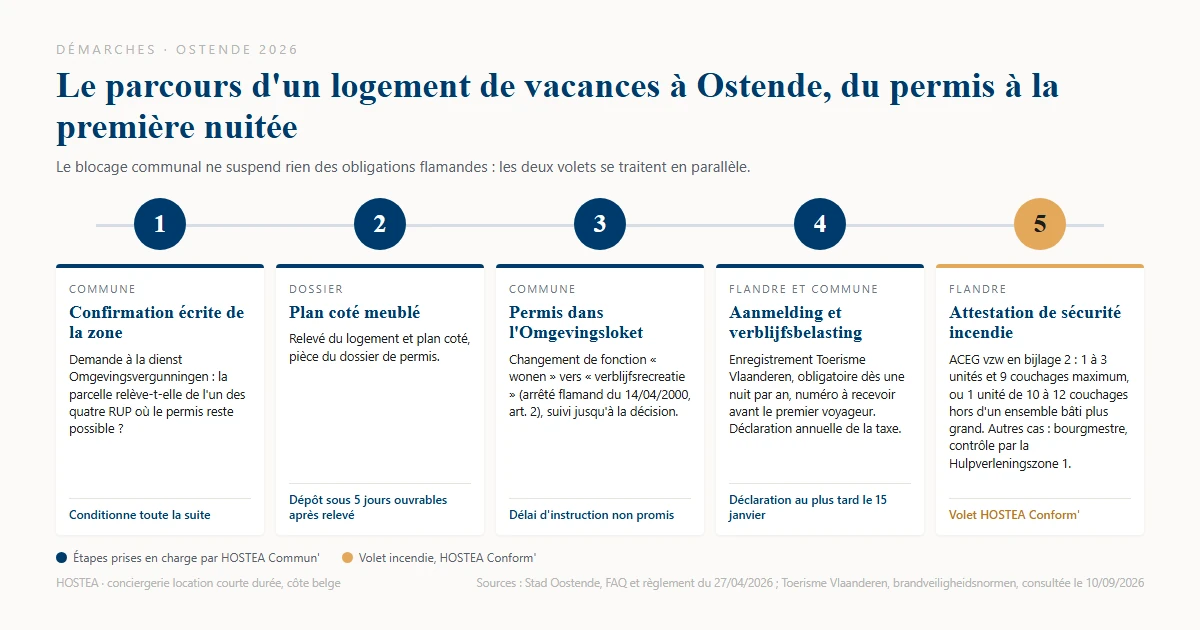
HOSTEA Conform' remains responsible for the fire safety side: audit, ISO 7010 signage, evacuation plan, fire extinguisher and detectors, and attendance at the ACEG inspection.
Check which zone my property is in
Book an appointmentFrequently asked questions
Can you still obtain a holiday rental permit in Ostend in 2026?
How much are the municipal taxes on a holiday apartment in Ostend?
Do you have to pay the tax if the property has no permit?
Does the exemption for four periods of thirty days protect an Ostend owner?
What does HOSTEA Commun' do for a holiday let in Ostend?
About the author
Victor Timmermans runs HOSTEA, a short-term rental property management company on the Belgian coast, from De Panne to Knokke. HOSTEA currently manages seven properties and supports owners with Logiesdecreet compliance, application by application, municipality by municipality. The regulations cited here were read in their published version, not summarised from an overview page.
This article is for information purposes and does not replace professional advice. Have your situation checked by the City of Ostend, your accountant or your adviser before making any binding decision.
Official sources
- Stad Oostende, verblijfsbelasting, municipal council regulation of 27/04/2026, published on 29/04/2026 (Bekendmaking 2026/019).
- Stad Oostende, belasting op de tweede verblijven, municipal council of 13/12/2025, published on 15/12/2025 (Bekendmaking nr. 42).
- Stad Oostende, FAQ omgevingsvergunningen (https://www.oostende.be/veelgestelde-vragen-omgevingsvergunningen), including point 4 "Tijdelijke vakantieverhuur zonder omgevingsvergunning" with the per-let count and the example of families X and Y, and the page "Appartement of woning verhuren als vakantielogies", accessed on 14/09/2026.
- Stad Oostende, dienst Omgevingsvergunningen, written reply to HOSTEA of 11/09/2026: municipal policy vision not adopted, with no known date, list of the four RUPs complete and up to date, per-let count of the 4 × 30-day exemption.
- Besluit van de Vlaamse Regering of 14 April 2000 (functiewijzigingsbesluit), article 2, § 1 and § 3, consolidated version as at 28/07/2025.
- Vrijstellingenbesluit of 16 July 2010, article 7.3 (version of 23/02/2017), consolidated Flemish codex, reread on 14/09/2026.
- Flemish decree of 5 February 2016 on tourist accommodation (Logiesdecreet).
- Stad Oostende, RUP Kustfront, stedenbouwkundige voorschriften (articles 1 and 6), Omgeving Vlaanderen DSI platform.
- Stad Oostende, RUP Raversijde, stedenbouwkundige voorschriften (article 1), definitively adopted on 30/03/2026, DSI platform.
- Stad Oostende (AGSO), RUP Hazegras, stedenbouwkundige voorschriften (articles 1 and 2), DSI platform.
- Stad Oostende, RUP Stedelijke Economische Verweving, stedenbouwkundige voorschriften (article 1, Multifunctioneel Stedelijk Woongebied), DSI platform.
- Toerisme Vlaanderen, brandveiligheidsnormen voor logies (ACEG vzw, bijlage 2), accessed on 10/09/2026.
- Toerisme Vlaanderen, aanmelding van een toeristisch logies page (registration number before the first guest), accessed on 10/09/2026.
- Vinçotte, page "Brandaudit toeristische logies", end of the collaboration with Toerisme Vlaanderen on 28/09/2025, accessed on 10/09/2026.
- HOSTEA, comparison of the 2026 municipal taxes of the nine coastal municipalities, regulations read in full, situation as at 14/09/2026: basis for the statement "highest rate on the coast for 4 to 6 sleeping places" (all nine 2026 regulations are published and have been read) (Knokke-Heist, €260 per sleeping place, exceeds €2,011 from 8 sleeping places).
Last updated: 14 September 2026. Changelog: article created on 10 September 2026, permit freeze, four RUP zones, 2026 municipal taxes and update on the intermediary as liable party; corrections on 10 September 2026 after review (RUP Hazegras, ACEG source, HOSTEA Commun' offer); third pass the same day (bijlage 2 thresholds, Hazegras toelichting); 14 September 2026: the City's written position on how the 4 × 30-day exemption is counted, freeze confirmed with no date, list of the four RUPs confirmed; the same day, after review: distinction between the City's written count and HOSTEA's conclusion on the exemption, official FAQ cited as a public source, tax comparison limited to 4 to 6 sleeping places.