
Updated on 10 September 2026
By Victor Timmermans, founder of HOSTEA · Published on 10 September 2026 · Reading time 6 min
Bredene is a municipality where reading errors are costly, because two municipal taxes look alike and a wrong intuition leads to budgeting eight times less than reality. This guide summarises the two regulations adopted on 18 December 2025, read in their entirety.
Which municipal tax actually applies?
The tax on second residences, not the lodging tax. Article 7 of the lodging regulation and Article 6 of the second residences regulation establish a mutual exclusion. The second residence tax takes precedence.
| Scenario | Tax due in 2026 |
|---|---|
| Apartment rented for a short duration, with a person registered at the address on 1 January | Lodging tax, €130 |
| Apartment rented for a short duration, without anyone registered on 1 January | Second residence tax, €1,062 |
Source: municipal regulation of Bredene on tourist accommodations (municipal council of 18 December 2025, point 47, adopted by 17 votes in favour, 1 against and 4 abstentions) and regulation on second residences (same session, point 48, adopted by 18 votes in favour, 0 against and 4 abstentions); written confirmation from the municipality's finance department dated 11 September 2026.
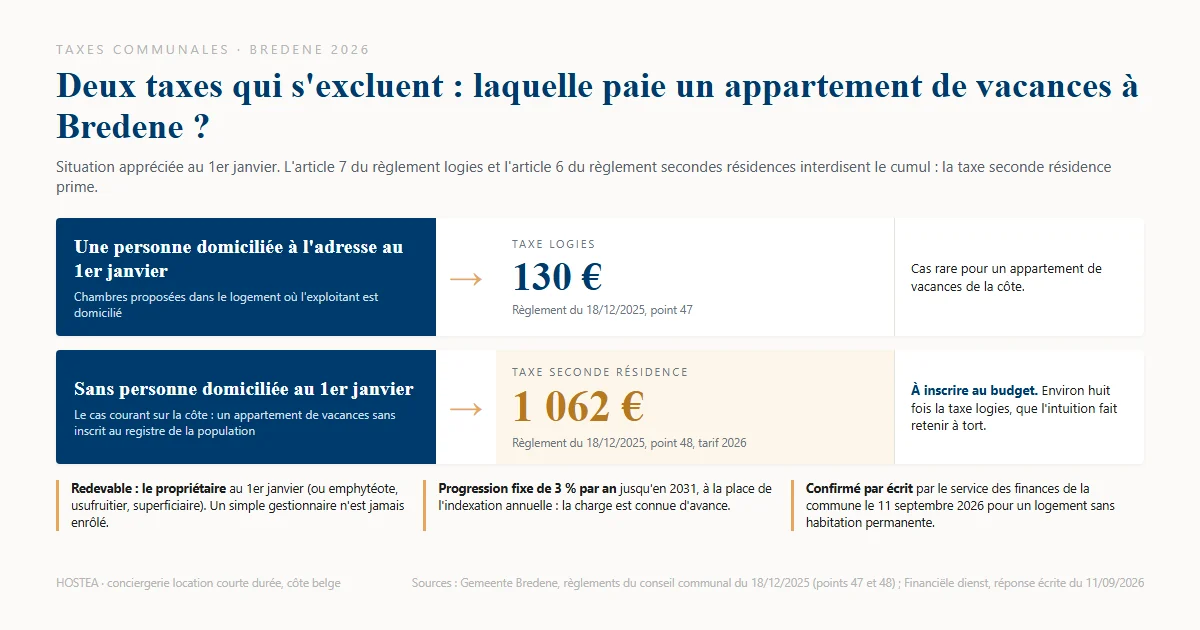
The current case on the coast is the second: a holiday apartment has no one registered in the population register. Therefore, it is €1,062 that must be included in the budget, not €130.
This interpretation was confirmed in writing by the municipality's finance department on 11 September 2026. A property without permanent residence is taxed as a second residence. The lodging tax targets, according to the municipality, the rooms offered in the property where the operator is registered. The doubt between the two regulations is therefore resolved for the standard case of a holiday apartment.
Two points of the 2026 regulation are worth noting. The annual indexing has been replaced by a fixed increase of 3% per year, making the charge predictable until 2031. And a solidarity clause has been added compared to the previous regulation of 19 December 2022.
Who pays: the owner or the concierge?
The owner. It is written in both regulations, and this distinguishes Bredene from Ostend, where the definition of the liable party also targets the intermediary who markets the property.
In Bredene, the accommodation tax is owed by the owner, with solidarity from the operator and the landlord, and the second residence tax is owed by the owner on 1 January of the financial year. A concierge does not become liable by publishing the advertisement. In practice, this simplifies the re-invoicing clause of a management mandate: the charge remains with the owner, and it is known in advance.
The finance department of the municipality confirmed it in writing on 11 September 2026. The liable party is the owner or, where applicable, the emphyteutic leaseholder, the usufructuary or the holder of surface rights. A simple holiday home manager cannot be designated as liable: the municipality always addresses the owner. The municipality does not comment on the clause making the operator jointly and severally liable, set out in Article 3 of the lodging regulation. This text remains applicable, but in practice, it is the owner whom the municipality assesses.
Is a planning permit required?
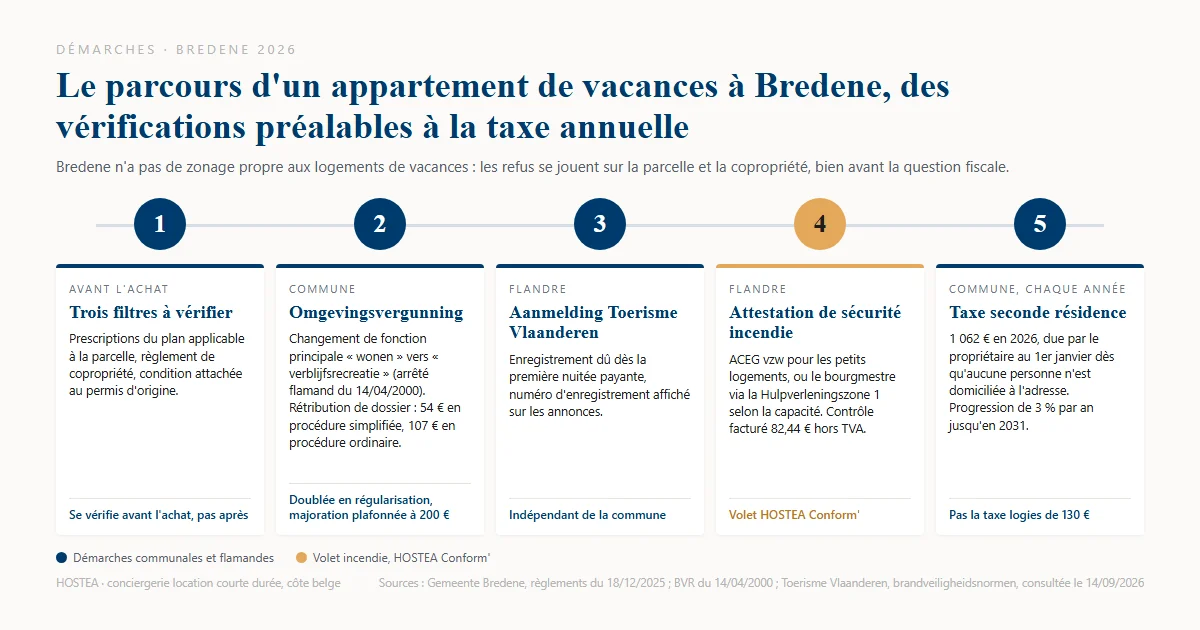
Yes, according to the ordinary Flemish regime. The change from the function "wonen" to the function "verblijfsrecreatie" is a change of main function subject to omgevingsvergunning, under the decree of the Flemish Government of 14 April 2000.
Bredene has not published zoning specific to holiday homes. What may prohibit renting at a given address are the prescriptions of the plan applicable to the plot, a condominium regulation, or a condition attached to the original permit. These three filters are checked before the purchase, not after.
In terms of cost, the municipality charges a file fee for the omgevingsvergunning: €54 in 2026 for the simplified procedure, €107 for the ordinary procedure. These rates are doubled in the case of regularisation, with an increase capped at €200 per file (fee regulation of 18 December 2025, Article 2). Any architect fees are additional.
Does the 4 × 30 days exemption provide protection?
The text exists: article 7.3 of the Vrijstellingenbesluit exempts from permits a temporary change of main function limited to four periods of thirty consecutive days per calendar year.
But a decision from the Antwerp Court of Appeal on 26 June 2019 holds that this article does not allow for the permanent adaptation of a building for a specific function, even while remaining below the threshold of 120 days. A furnished and equipped apartment permanently for the reception of tourists, advertised all year round on platforms, would therefore not fall under the exemption even if it is only rented for a hundred nights. This interpretation comes from a secondary legal analysis and not from the text of the ruling itself: treat it as a strong signal to be confirmed, not as a certainty.
Our position is simple: we do not build a mandate on this exemption.
What Flemish obligations remain due?
Two, independent of the municipality, applicable from the first paid night:
- The registration with Toerisme Vlaanderen, with registration number displayed on the advertisements.
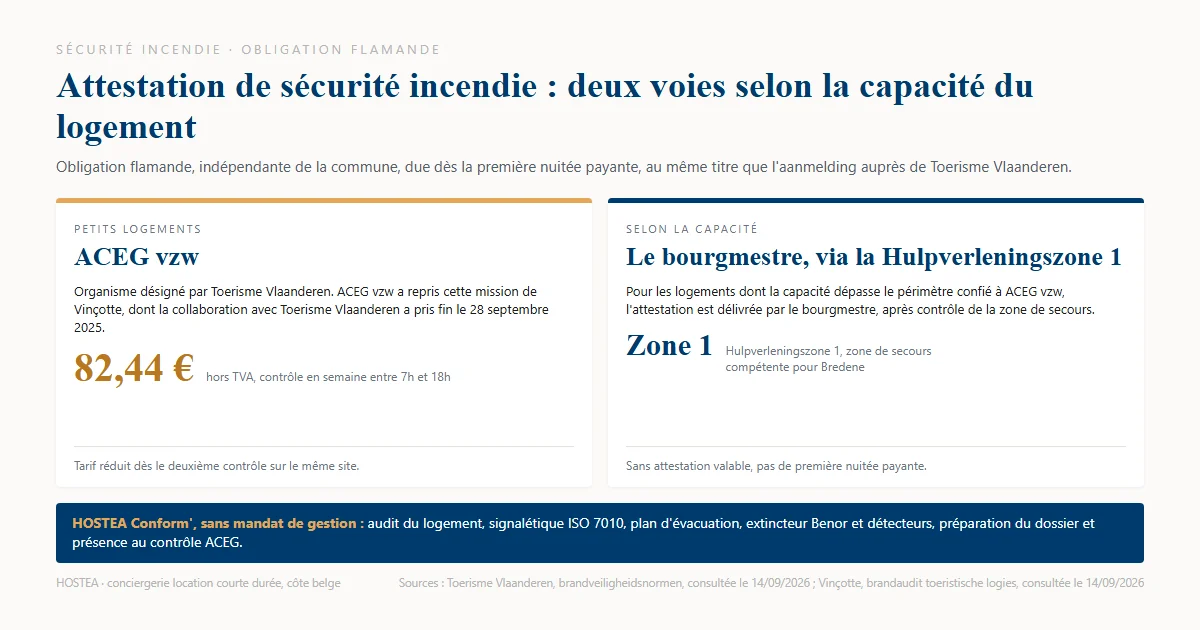
- The fire safety certificate, issued by ACEG vzw for small dwellings, or by the mayor via Hulpverleningszone 1 according to capacity. ACEG vzw has taken over this mission from Vinçotte, whose collaboration with Toerisme Vlaanderen ended on 28 September 2025. The inspection is charged at €82.44 excluding VAT during the week between 7 am and 6 pm. A reduced rate applies from the second inspection at the same site (Toerisme Vlaanderen, ACEG rates consulted on 14 September 2026).
How HOSTEA Conform' puts you in compliance
HOSTEA Conform' takes care of fire compliance, without a management mandate: housing audit, ISO 7010 signage, evacuation plan, Benor extinguisher and detectors, preparation of the file and presence at the ACEG inspection.
In Bredene, we also check two things before any commitment: the applicable plan for the plot, and the co-ownership regulations. This is where most refusals occur, well before the tax question.
Make an appointment for a Conform' quote
Book an appointmentFrequently asked questions
What tax does a holiday apartment in Bredene pay in 2026?
Can the concierge be liable for the tax in Bredene?
Will the rate increase by 2031?
Is a permit required to rent for a few weeks a year?
About the author
Victor Timmermans runs HOSTEA, a short-term rental concierge on the Belgian coast, from La Panne to Knokke. HOSTEA currently manages seven properties and reads the municipal regulations in their text, article by article, before deriving a figure.
This article is for informational purposes and does not replace professional advice. Have your situation validated by the municipality of Bredene, your accountant, or your advisor before making any binding decisions.
Official sources
- Municipality of Bredene, tax regulation for second residences, municipal council of 18/12/2025, point 48, article 6 (reciprocal exclusion), financial years 2026 to 2031.
- Municipality of Bredene, tax regulation for room-related lodgings, municipal council of 18/12/2025, point 47, article 3 (liable party) and article 7 (reciprocal exclusion).
- Municipality of Bredene, fee regulation for environmental permits, municipal council of 18/12/2025, article 2 (rates 2026 and doubling in regularisation).
- Tourism Flanders, Fire safety in lodgings (designation of ACEG vzw, rates excluding VAT), https://toerismevlaanderen.be/nl/logies/brandveiligheidsnormen, consulted on 14 September 2026.
- Vinçotte, Fire audit for tourist lodgings (end of collaboration with Tourism Flanders on 28 September 2025), https://www.vincotte.be/nl/brandaudit-toeristische-logies, consulted on 14 September 2026.
- Decision of the Flemish Government of 14 April 2000 (decision on function changes), article 2.
- Exemption decision of 16 July 2010, article 7.3; Court of Appeal of Antwerp, ruling of 26 June 2019, cited by a secondary legal analysis.
- Flemish decree of 5 February 2016 on tourist accommodations (Logiesdecreet).
- Municipality of Bredene, Financial service, written confirmation of 11/09/2026 on the application of the second residence tax to properties without registered residents and on the liable party (correspondence HOSTEA).
Last updated: 14 September 2026. Changelog: 10 September 2026, creation of the article, mutual exclusion of the two taxes, liable owner, progression of 3% per year until 2031. 14 September 2026, written confirmation from the municipal finance department: housing without a registered occupant taxed as a second residence, liable owner, manager never assessed. 14 September 2026, corrections after independent proofreading: omgevingsvergunning fee reduced to €54 and €107 (doubled in regularisation), votes distinguished between point 47 and point 48, ACEG takeover reworded with the sourced date of 28 September 2025, articles 7 and 6 specified, ACEG rate excluding VAT, publication date aligned with 11 September 2026.